Visible but Not Heard
World Listening Day

July 18th is World Listening Day, a day devoted to the importance of listening. But this year I’m wondering if listening is really the whole story. What if the real challenge isn’t how well someone listens, but whether the conditions exist for someone to be not only seen but heard, too?
A short film by the Japanese studio Coneco Film pointedly explores this dilemma. It begins with a group of employees discussing who should lead an important project. One by one, several colleagues recommend the same candidate. She is experienced, capable, and respected. There is only one problem. She is also the only woman at the table.
The senior manager’s discomfort is visible and grows with every recommendation. But after the third employee says he has worked with her and believes she’s the one for the role, he finally relents.
“Fine,” he says. “For optics, let’s put her in charge.”
At first glance, the film appears to be about the senior manager’s gender bias. And it is. But then it goes deeper. As soon as the appointment is confirmed, the conversation moves on without anyone asking the new project lead whether she accepts the appointment. She is fully visible. Yet nobody asks what she thinks.
Forced to interrupt the discussion, the newly appointed leader stands up to join the conversation. She explains that if she is being chosen because she is a woman, she would rather decline the role. If, on the other hand, she is being chosen because of her abilities and track record, she would be pleased to accept. For a moment, the room falls silent. Then the conversation changes.
People can be consulted through surveys, included in meetings, represented in discussions, and even invited to participate, yet still struggle to influence what happens next. I’ve been exploring this idea through the metaphor of an iceberg. What we hear on the surface is only part of the story.
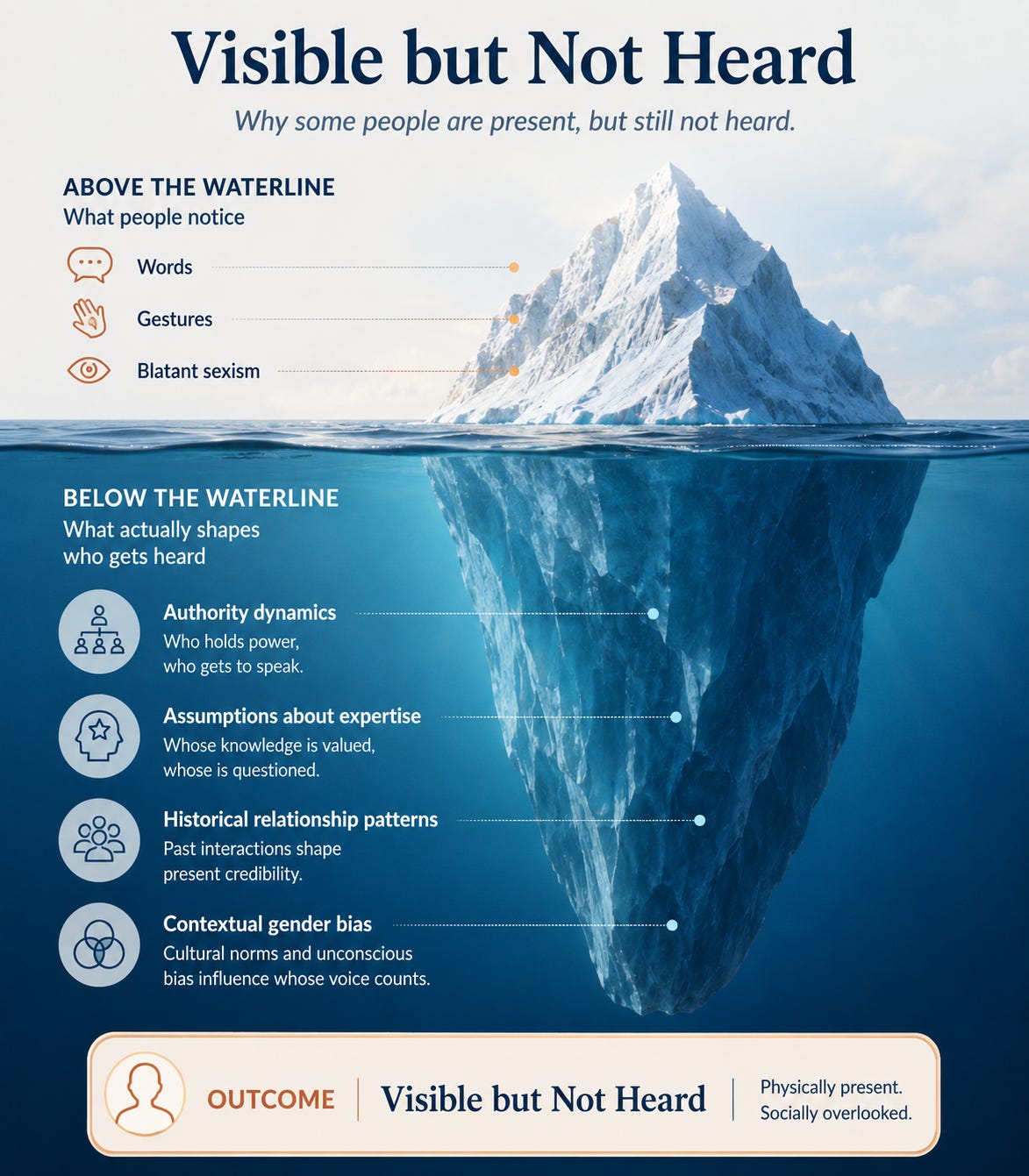
Most communication problems are treated as message problems. We ask whether something was explained clearly enough, repeated often enough, communicated through the right channels and delivered with the right tone and gestures. But sometimes the challenge lies not in the message itself but in the cultural dynamics that make it hearable. Who holds the power? Who gets to speak? Whose knowledge is valued? Whose knowledge is questioned?
For these questions, trust, the history of the relationships and the stories people tell about one another matter. Expectations matter, as does a sense of agency, and the timing of delivery. I am exploring these as some of the cultural dynamics that make ideas hearable. My working hypothesis is that visibility allows people to be present, but hearability allows them to influence what happens next. It is hearability, not visibility alone, that allows a conversation to change.
On this World Listening Day, I’d love to know what you think helps ideas gain traction, and what enables a person to be heard.
You can watch the Coneco Film short that inspired this reflection here.
I recently read a good book called Fix the System, Not the Women by Laura Bates that shows how men are guilty of mansplaining which is occurring in the Japanese documentary
Thank you so much for the interesting essay. I'm not sure right to say here, I often wonder when people don’t understand each other’s words, people don’t want to understand each other. So communication can be across only when people want to try knowing each other’s beyond the words.