The Rose in the Pine

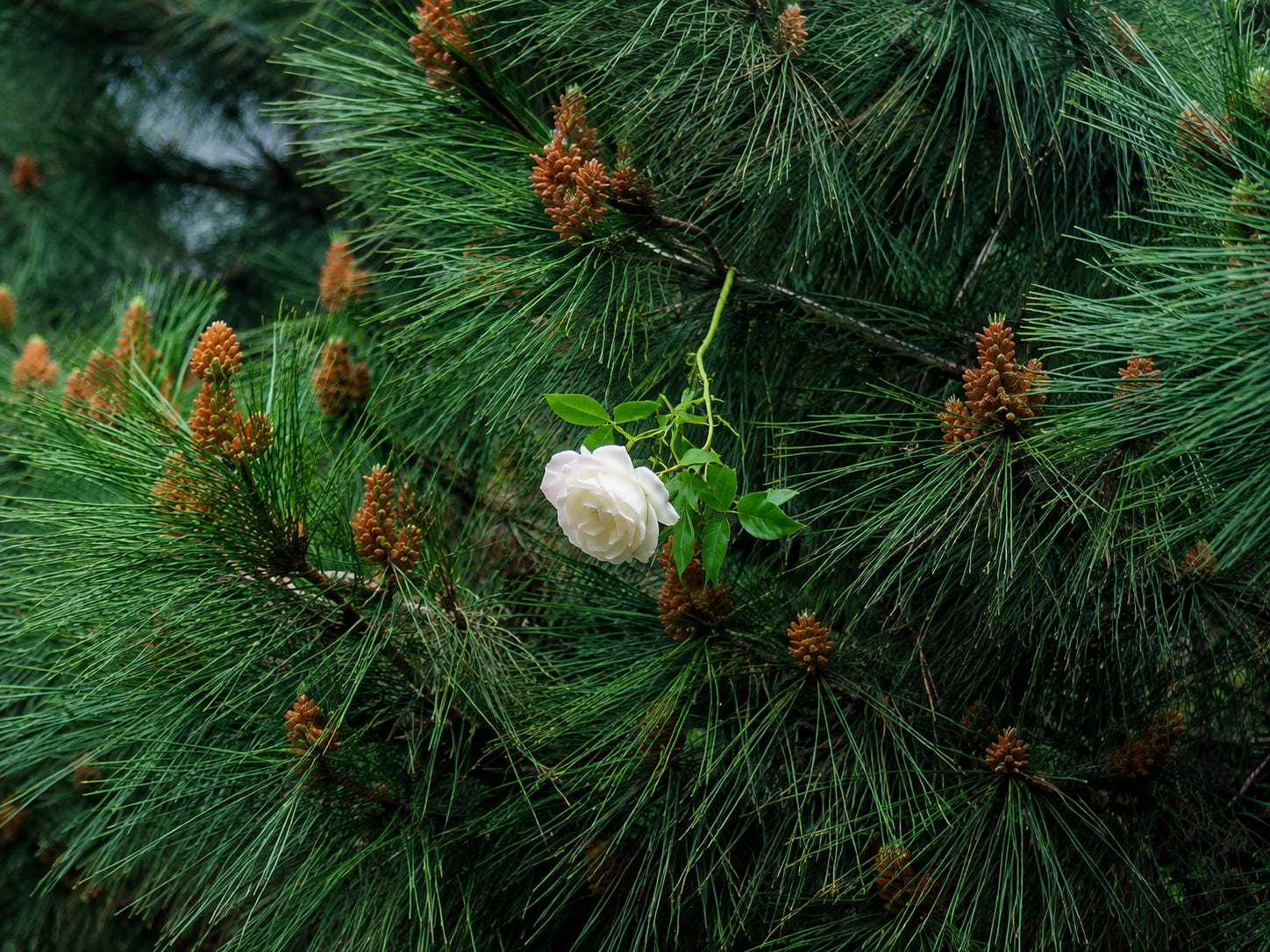
One day I looked out into our garden and saw a rose growing from the middle of our overgrown pine tree. I imagined a rose cane that had casually wandered across the fence from our neighbour’s side and somehow found its way between the pine branches. But the closer I looked, the more it seemed like the rose wasn’t climbing through the tree. It looked like it had been grafted onto one of the branches. Was that even possible?
I rushed to my laptop to investigate, and switching from the text on the page to the internet, I madly tapped out my question, while my busy brain wondered if the rose was actually me, poking my face through from amongst the evergreen pine needles. But refocussing my attention the next quarter of an hour on my query, I began to read up on plant grafting.
But almost as soon as I began my investigation, I learned that it is almost impossible for a rose to be grafted onto a pine. Deflated that I hadn’t made the discovery that a rose could grow up amongst rose pine needles and cones, I glanced back at the pale white flower and realised I had stumbled across something equally as important as a grafted plant, and it was this.
Noticing often announces itself through difference.
I had forgotten about my overgrown pine tree until the rose peeked out from amongst the needles. When something out of the ordinary happens, we notice it.
Once I saw the rose in pine through this experience, I found it everywhere. In my own focus of the study of language, I could see how we don’t notice the language we’re speaking until we hear an unfamiliar accent. We don’t think about pausing in communication until that one silence that lasts a beat too long. We don’t notice a gesture until it gets used in a way we usually wouldn’t. When something doesn’t quite match our habitual way of understanding the world, we notice it.
Then I also realised something else the rose in the pine taught me that day. Noticing begets more noticing. The unusual experience of encountering a rose in a pine led me to look up information on grafting. Noticing rarely ends with a single observation. It sends us looking for another.
Last week I wrote about how my grandmother picks good watermelons. I wanted to learn how she was noticing, and asked until she eventually told me how she could tell a good watermelon by the deep resonant reply she got when she knocked on its rind. Back then, it all seemed like a wildly unattainable skill to acquire. I just thought my grandmother had some crazy shaman-like ability to tell good watermelons from bad ones.
But now many reflections later, I know my grandmother wasn’t a shaman. It wasn’t wizardry that my grandmother had but expertise, something she developed from listening to the sound of multiple watermelons over many many summers, the same way a gardener sees signs of a changing season that others walk straight past after years of planting, pruning, weeding and maybe even grafting. Or, the same way a parent notices the smallest shift in a child’s mood after nights of putting them to bed, waking them up and walking them to school, and the way a linguist hears the meaning carried by a pause after observing them in a variety of different situations. Expertise is a recognition that grows through repeated noticings.
The reward of repeated noticings isn’t just more understanding. It’s developing recognition, then expertise, which ultimately not only helps us understand the world around us, but also the person doing the noticing. Noticing reveals something about ourselves.