Not Closed. In Preparation
Increasing the hearability in a room

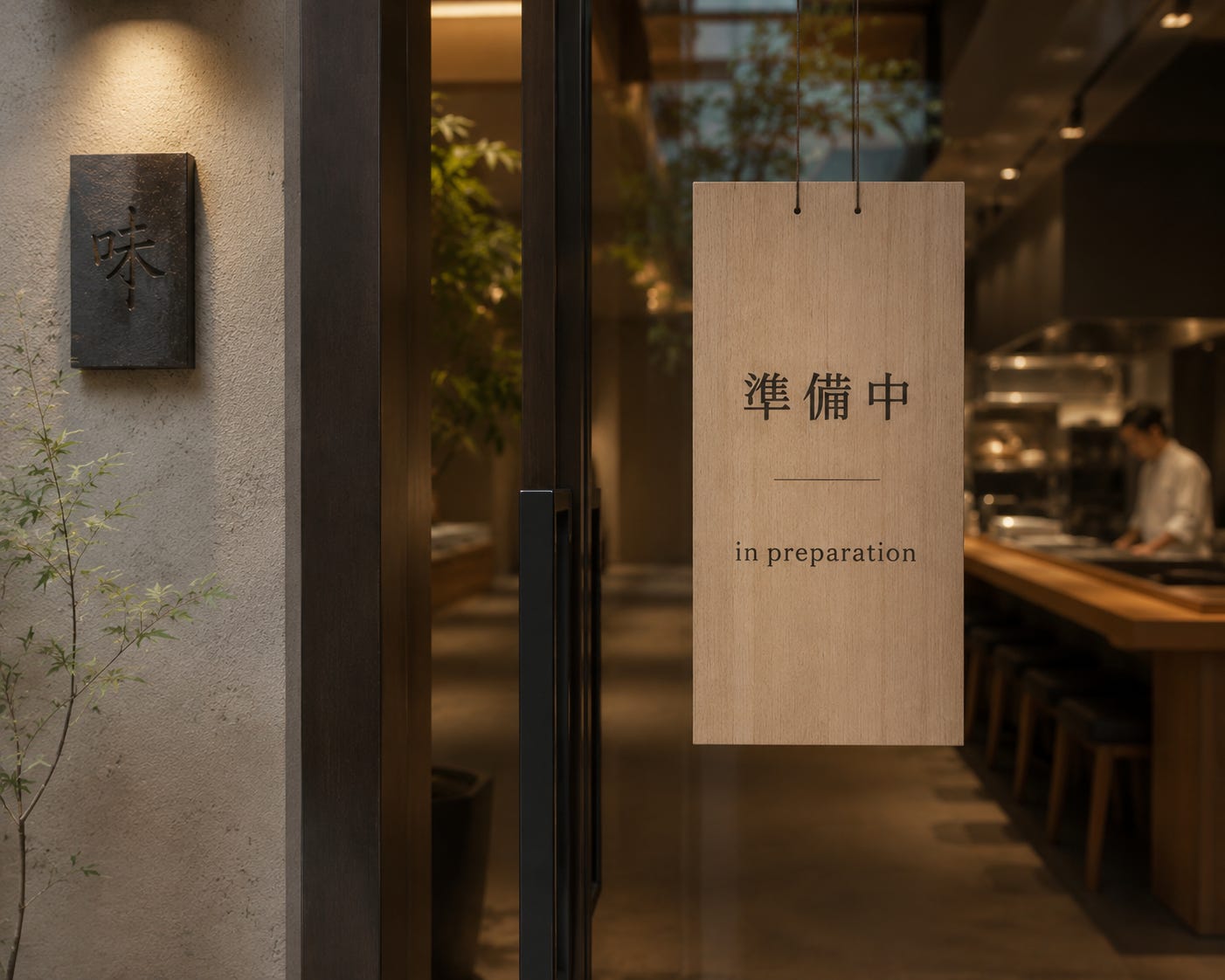
One of the first things visitors to Japan notice is the sign hanging in the window of a shop. In English, a shop is usually either OPEN or CLOSED. But in Japan, the signs tell you a shop is IN OPERATION 営業中 (eigyōchū) or IN PREPARATION 準備中 (junbichū).
While both sets of signs tell us the information we need to know regarding the accessibility of the store, they also each tell us something different. Whereas the open and closed shop signs tell us about the definite status of the shop, the in-preparation and in-operation signs tell us about the process the shop is undergoing by the people who are getting the shop ready for us.
A visitor once described the Japanese signs as ambiguous. “Is it open when it’s in preparation or isn’t it?” To them, the signs made it sound like a shop that couldn’t make up its mind, or admit it was fully closed. I laughed, understanding how the signs could be confusing. A description of a shop that is open or closed sounds much more certain than an account of an ongoing process that would eventually end in these fixed states.
We are socialised to want certainty because the definitiveness is attractive. It helps us know where exactly we stand, what something means, whether a relationship is working, whether an idea is right, whether a conversation has been resolved. Certainty helps us reach decisions, and decisions make us feel that the world is under control.
Meanwhile, though, life is out there, refusing to cooperate because circumstances beyond our control change. As new information appears and relationships evolve, certainty waxes and wanes in both directions. What seemed impossible last year becomes imaginable now, but equally, things that felt certain yesterday become less certain today. And in the middle of it all, when the environment we live in changes, we are constantly being asked to navigate uncertainty.
The philosopher Charles Sanders Peirce offered a phrase that can help us navigate through this uncertainty. He called it “perpetual readiness,” a willingness to remain open to what may emerge next. Peirce believed that life constantly presents situations too complex to be solved by formal reasoning alone. We can’t prepare a script for every encounter, but we can develop an ability to adapt. We can stay ready.
As a child who moved between countries, I didn’t have a name for this. I only knew that adaptability was essential for my own survival. Every move required learning new rules, new expectations, and new ways of speaking and listening. There was no choice but to remain open to the possibility that what worked yesterday might not work tomorrow.
This is why children often do surprisingly well in perpetual readiness. They enter unfamiliar situations expecting to tumble and turn and learn something in the process. Adults, by contrast, become attached to certainty over time. Acquiring knowledge on how things are done means we become the experts of our own habits and assumptions that make the world feel manageable.
The only problem is that the world continues to change anyway. Perpetual readiness gives us an alternative, a beginner’s orientation that helps us adjust to our changing circumstances so we can test assumptions and notice new patterns. When we discover that another person’s experience doesn’t fit our expectations, perpetual readiness allows us to listen adaptively, helping us revise our realities.
In the book, KIKU, I wrote about how the Adaptive Listening channel helps us adjust to changing circumstances. As we open ourselves to listen and prepare to read the room, we are better able to discern its emotional temperature as well as a host of other conditions like personal or cultural history that breathe hearability into a space.
Whereas the potential for hearability is high in a space that is open, it is low in a space that is closed. When listeners have already decided what they are going to hear, who is right and who is wrong, or if defending a position is more important than discovering something new, that space is closed.
And this is when being in preparation like the Japanese signs can help. Even when we aren’t fully open, we are not closed. We are in preparation, working with Peirce’s idea of perpetual readiness so that we can prepare ourselves to adapt to new circumstances, and to open up possibilities of what can come next.
Thanks for reading! Subscribe for free to receive new posts and support my work.
I very much like the concept of perpetual readiness
I really like the terminology you have highlighted for flexibility. It helps me think of some of the concepts in new ways. Thank you.